
LG has spent years connecting washing machines, refrigerators, TVs and air conditioners to its ThinQ platform. ThinQ Claw is an attempt to make those connections less visible.
Instead of opening an app, choosing an appliance and adjusting a setting, LG wants you to be able to tell your home what is happening and let the system work out what needs to be done.
That is the idea behind LG ThinQ Claw, a new text-based AI agent that made its public debut at IFA 2026. LG says it can understand both the intent behind a request and the context around it, then coordinate connected appliances and services accordingly.
It is a significant change in direction for ThinQ. But there is also an important caveat: ThinQ Claw is still much closer to a demonstrated AI Home concept than a universally available consumer feature.
As of September 28, 2026, LG has not published a general release date, complete list of supported countries or definitive compatibility list.
So what exactly is ThinQ Claw, how does it differ from the ThinQ app we already know, and what could it mean for an LG smart home?
- LG ThinQ Claw is LG’s new AI agent for the smart home, introduced at IFA 2026.
- Instead of controlling appliances one by one, Claw is designed to understand your intent, routines and household context and coordinate connected devices accordingly.
- It forms part of LG’s wider AI Home ecosystem, alongside ThinQ, ThinQ ON and Homey.
- LG has demonstrated uses such as adapting routines, preparing the home before you arrive and coordinating kitchen appliances.
- ThinQ Claw is not yet broadly available. LG has not published a general release date, complete compatibility list or full regional rollout plan.
What is LG ThinQ Claw?
ThinQ Claw is an AI agent for LG AI Home that users interact with through natural-language text conversations.
That description matters because an AI agent is supposed to do more than answer a question. It can interpret what you want to achieve, determine which actions are required and interact with connected systems to carry them out.
LG gives a simple example. Instead of creating several separate smart-home automations before guests arrive, you could tell ThinQ Claw that people are coming over. The agent could then use that information to suggest or initiate relevant actions involving connected kitchen appliances and other services.
The same principle can apply elsewhere in the home.
LG says ThinQ Claw can take information such as your schedule, routines, household conditions and appliance usage into account. It can also work with connected services such as calendars and remember stated preferences over time.
That makes it fundamentally different from issuing a command such as:
“Set the air conditioner to 21°C.”
With a contextual agent, the interaction could instead be closer to:
“I’ll be home in an hour and it has been really hot today.”
The system would then need to understand what that means, look at the available information and decide whether adjusting the indoor climate is appropriate.
That is the promise, at least.
ThinQ Claw vs LG ThinQ: what is the difference?
The current LG ThinQ app already lets users monitor and control compatible appliances, receive notifications, use Smart Diagnosis, manage settings and create certain routines.
If you are unfamiliar with the existing platform, our guide to What is LG Smart ThinQ? explains the basics before the addition of ThinQ Claw.
ThinQ Claw adds another layer on top of that ecosystem.
| LG ThinQ today | LG ThinQ Claw | |
|---|---|---|
| Main interaction | App controls, menus, routines and commands | Natural-language text conversation |
| Typical approach | Tell a specific device what to do | Explain your intent or situation |
| Context | Device states, settings and configured routines | Schedules, routines, preferences and household context |
| Actions | Mainly individual device functions and predefined automation | Intended to coordinate multiple devices and services |
| Personalization | Depends on appliance and existing ThinQ features | Designed to remember likes and dislikes over time |
| Availability | Already available on supported products | Announced and demonstrated; wider rollout not yet confirmed |
This does not mean that the existing ThinQ platform lacks automation or AI. Several LG appliances already use automated functions, recommendations and remote controls.
The important difference is how LG wants users to interact with the smart home.
With traditional home automation, the user normally defines the logic. You create the schedule, choose the trigger and decide what happens next.
ThinQ Claw is designed to shift some of that work to the agent.
What can LG ThinQ Claw actually do?
LG showed several practical examples around IFA 2026 rather than limiting its announcement to abstract AI terminology.
Preparing food based on what you have at home
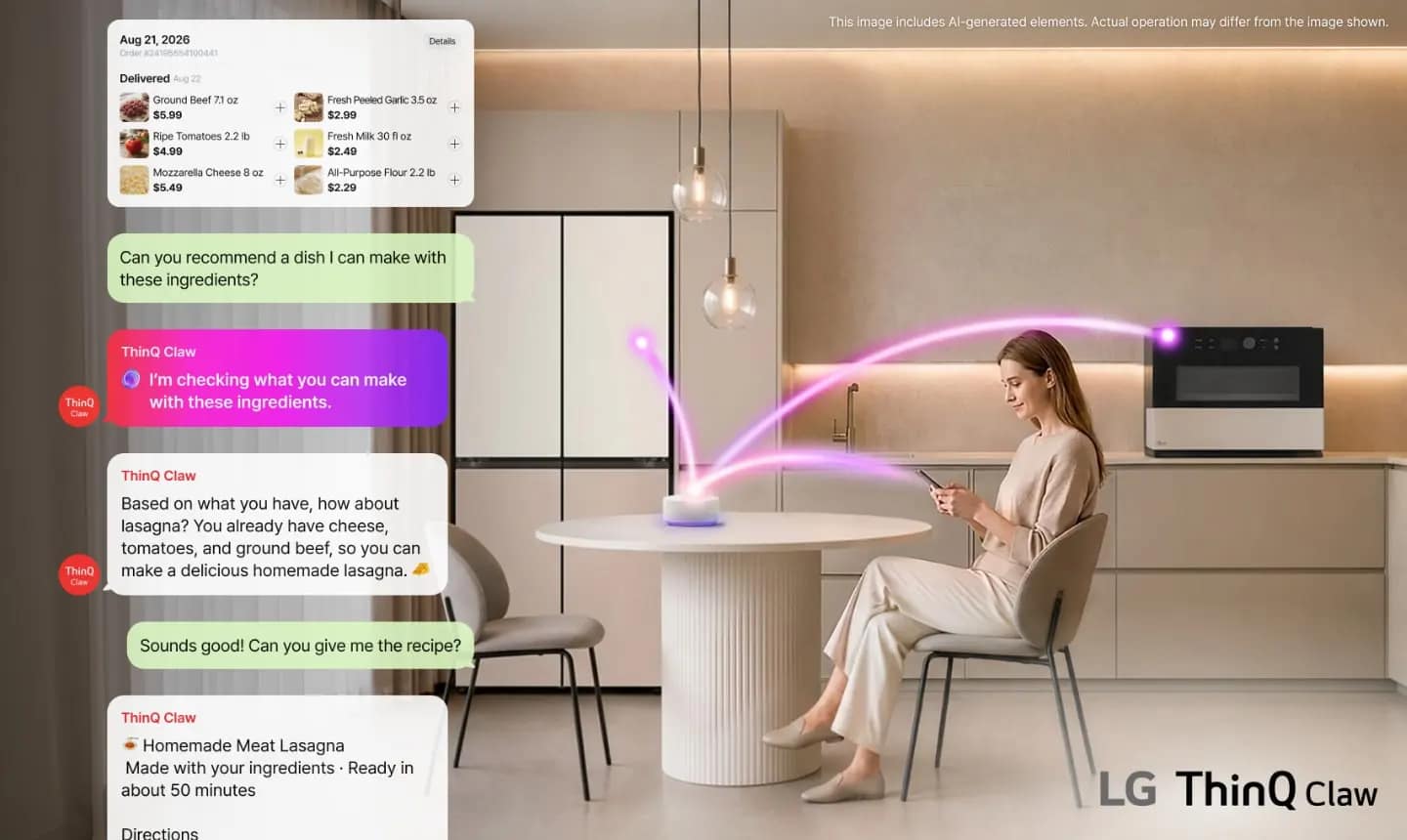
One of LG’s demonstrations shows ThinQ Claw reviewing recent grocery information, considering available ingredients and suggesting a homemade lasagna.
The interface then connects the recommendation to appliances such as the refrigerator and oven.
The interesting part is not the recipe recommendation itself. Plenty of AI chatbots can generate recipes.
The useful part would be the connection between that recommendation and the actual appliances in your kitchen.
If implemented well, an AI agent could eventually move from telling you what to do to preparing the devices required to do it.
Adjusting the home before you return
LG also describes ThinQ Claw checking factors such as indoor temperature and air quality before someone arrives home.
Instead of manually opening the ThinQ app and adjusting individual devices, the agent could use current conditions and known preferences to recommend appropriate settings for an air conditioner, purifier or other connected appliance.
Adapting routines when your schedule changes
Another demonstration involves an upcoming school break.
Rather than expecting the homeowner to rewrite existing schedules, ThinQ Claw can recognize that the household routine is changing and suggest adjustments to devices such as climate control and a robot vacuum.
This is arguably one of the more practical ideas behind contextual AI.
Traditional smart-home schedules work well until real life stops following the schedule.
Preparing the house when you travel
LG has also shown a travel scenario in which the system recognizes that the household is leaving and suggests actions such as switching off lights and a TV or temporarily pausing certain home automations.
Again, none of these individual actions are revolutionary.
The difference is that one piece of information — we are leaving for a trip — can potentially trigger a series of relevant suggestions without the user programming every condition beforehand.
LG demonstrated how ThinQ Claw could work across different everyday situations during IFA 2026. The video below gives a useful overview of how LG envisions the AI agent interacting with connected appliances and the wider smart home.
Homey may be just as important as the AI
ThinQ Claw is only one part of a much bigger change taking place inside LG ThinQ.
LG says its open AI Home ecosystem is powered by Homey, the smart-home platform created by Dutch company Athom. LG acquired Athom in 2024.
Homey is important because LG cannot build a genuinely useful smart home if it only understands LG products.
Most homes contain devices from multiple manufacturers: smart bulbs from one company, thermostats from another, a third-party EV charger, solar inverter, speakers, sensors and household appliances from several brands.
Homey was built around this kind of mixed environment.
At IFA, LG demonstrated a Home Energy Management System in which Homey connects smart meters, solar panels, home batteries and EV chargers with LG appliances. The objective is to coordinate when energy is generated, stored and consumed, including around dynamic electricity tariffs where available.
That gives ThinQ Claw a potentially much wider field to work with.
There is one important distinction, though.
LG saying that AI Home is powered by Homey does not mean that every Homey-supported device automatically works with ThinQ Claw today.
The Homey community has already raised similar questions. At the moment, LG has not explained exactly how existing Homey installations will interact with Claw or which third-party integrations will be exposed to the agent.
Where does ThinQ ON fit in?
ThinQ Claw is also closely connected to LG ThinQ ON, LG’s dedicated smart-home hub.
LG demonstrated ThinQ Claw as a text-based AI agent integrated with ThinQ ON during IFA 2026.
ThinQ ON itself was introduced earlier as LG’s attempt to turn ThinQ from an appliance app into a broader smart-home platform. The hub was designed around technologies including Wi-Fi, Thread and Matter, while Homey software expands compatibility with third-party devices.
This combination makes more sense than looking at ThinQ Claw as a standalone chatbot.
Think of the different layers roughly like this:
ThinQ manages connected LG products and services.
ThinQ ON can act as part of the physical smart-home infrastructure.
Homey broadens the ecosystem beyond LG hardware.
ThinQ Claw is intended to become the conversational AI layer that understands what the user wants and coordinates the relevant parts.
The exact boundaries between those layers may change as LG rolls the system out.
What does OpenClaw have to do with ThinQ Claw?
There is another interesting detail in LG’s announcement.
LG says ThinQ Claw is “built on the concept of OpenClaw.”
OpenClaw is an open-source AI-agent platform designed to let an assistant interact with applications, services and tools on behalf of its user. It can connect to messaging platforms and carry out multi-step tasks rather than functioning only as a conversational chatbot.
That makes the conceptual connection fairly obvious: both systems revolve around an AI agent that can understand a request and then use tools to do something about it.
But LG’s wording should not be stretched further than that.
The company has not said that ThinQ Claw is simply a version of the open-source OpenClaw software, nor has it said that Claw inherits OpenClaw’s local-first architecture.
Until LG publishes more technical documentation, it would be misleading to assume either.
Is ThinQ Claw replacing Google Home or Alexa?
Not based on anything LG has announced so far.
Existing LG ThinQ products already offer integrations with Google Assistant and Amazon Alexa for supported appliances, features and markets. LG’s own support documentation still describes those integrations.
ThinQ Claw is different.
LG is positioning it as an intelligence layer within its own AI Home ecosystem rather than simply another voice assistant. The focus is on interpreting context and coordinating several actions rather than responding to one appliance command.
There may eventually be overlap with Alexa or Google Home, but LG has not explained how those services will interact with ThinQ Claw.
It is therefore too early to call Claw a replacement for either platform.
ThinQ Claw could solve a real smart-home problem
The smart-home industry has spent years making individual devices easier to connect.
Making the complete home easy to manage has proved much harder.
Anyone who has built more advanced automations will recognize the problem. A simple routine often turns into a collection of triggers, conditions, exceptions and device-specific settings.
A system that lets you describe the desired outcome could remove some of that complexity.
Rather than programming:
- If it is after 17:00;
- and someone is approaching home;
- and the temperature is above a set value;
- then start the air conditioner;
- unless a window is open;
you could theoretically tell an agent what you want the house to achieve and let it decide which available tools are appropriate.
That is a much more ambitious use of AI than adding a chatbot to an appliance app.
It is also much harder to get right.
The existing ThinQ ecosystem shows what LG still needs to prove
User discussions around LG ThinQ reveal several recurring concerns.
People regularly ask whether specific appliances will work with third-party platforms, whether older products will receive new integrations and whether control depends too heavily on LG’s cloud services. Home Assistant users, for example, have discussed compatibility differences between appliances and the limitations of cloud-based integrations.
Other users have reported difficulties connecting ThinQ to Google Home in particular regions or keeping integrations working consistently.
None of these discussions prove that ThinQ Claw will have the same problems.
They do show what potential users will expect LG to address.
For Claw to become genuinely useful, LG will need to make several things clear:
- exactly which appliances are supported;
- whether older ThinQ appliances remain useful;
- which features require ThinQ ON;
- how Homey integrations are exposed;
- which functions continue working during an internet outage;
- how third-party services are authorized;
- and how much control users retain over automated actions.
A smart-home AI agent becomes more powerful as it gains access to more devices and information. That also makes predictability and permissions more important, not less.
What about privacy?
Privacy deserves more attention with ThinQ Claw than it did with a simple remote-control app.
LG says its AI Home can consider schedules, routines, the home environment and appliance usage, while ThinQ Claw can interact with services including calendars and remember a user’s likes and dislikes.
That context is precisely what makes the system potentially useful.
It also means users should know exactly what information the agent can access.
LG’s current ThinQ privacy documentation says the wider service can process information including device registration details, device status, settings, usage history, power consumption, network information and interactions with the ThinQ service. Additional information can be processed when users enable specific features.
That does not mean ThinQ Claw automatically collects every category listed in LG’s privacy policy.
The more relevant question is which data Claw itself needs, where that processing happens and how long contextual information and remembered preferences are retained.
LG has not yet published enough Claw-specific technical information to answer all of those questions.
There is already visible interest in this topic among existing ThinQ users. Privacy and the amount of data required by connected appliances have been recurring discussion points on Reddit.
LG says its broader AI Home ecosystem is protected by its LG Shield security framework, but detailed Claw-specific controls will be important once the service reaches consumers.
Does ThinQ Claw support Matter?
This question needs careful wording.
LG’s wider smart-home strategy supports Matter through products including ThinQ ON, while Homey itself connects with several smart-home technologies and ecosystems.
That does not make ThinQ Claw itself a Matter controller.
Claw is better understood as the AI-agent layer: it interprets requests and attempts to coordinate whatever devices and services LG makes available to it.
Matter may help those devices communicate across ecosystems, but it is not the same thing as ThinQ Claw.
This distinction is especially relevant because existing LG owners have already been asking whether older ThinQ appliances will gain Matter support.
When will LG ThinQ Claw be available?
This is currently the largest unanswered question.
LG introduced ThinQ Claw on August 31, 2026 and demonstrated it publicly during IFA 2026.
However, LG has not announced a general consumer release date, price, complete country list or complete list of compatible products.
That means you should be cautious when reading claims that suggest ThinQ Claw is already a standard feature available to every ThinQ user.
For now, it is more accurate to describe it as LG’s next-generation AI Home agent that has entered the public demonstration stage.
We will update this article when LG confirms wider availability.
Why ThinQ Claw is worth paying attention to
The most interesting thing about ThinQ Claw is not the chat window.
It is the shift from controlling devices to expressing intent.
Smart homes have traditionally expected their owners to think like programmers. Choose the device. Choose a trigger. Add a condition. Build a routine. Fix it when somebody’s schedule changes.
LG’s approach is to move more of that logic behind a natural conversation.
If it works reliably, the smart home becomes less about operating technology and more about explaining what you need.
The difficult part begins after the IFA demonstration.
ThinQ Claw will need broad appliance compatibility, dependable integrations, sensible safeguards and transparent data controls before it can deliver on that idea in a normal home.
LG has shown what it wants the future of ThinQ to look like.
Now it has to make that future work.
Frequently asked questions about LG ThinQ Claw
What is the difference between LG ThinQ and ThinQ Claw?
LG ThinQ is the existing platform and app used to connect, monitor and control compatible LG appliances. ThinQ Claw is a newer AI agent designed to sit on top of LG AI Home. Instead of relying mainly on menus, individual commands and prebuilt routines, Claw is meant to understand a request in context, work out the required steps and coordinate several connected devices or services.
When will LG ThinQ Claw be available?
Not yet in a general consumer release. LG introduced and demonstrated ThinQ Claw at IFA 2026, but has not announced a broad launch date, list of supported countries or pricing. That distinction matters because many of the examples shown by LG are demonstrations of the AI Home concept. Check LG’s regional ThinQ information before assuming the feature is available on an existing appliance or account.
Will ThinQ Claw work with existing LG ThinQ appliances?
Possibly, but LG has not published a complete compatibility list. ThinQ Claw is part of the wider ThinQ and AI Home ecosystem, so existing connected LG appliances are clearly relevant to the concept. However, LG has not confirmed that every ThinQ-enabled washer, refrigerator, air conditioner, TV or other appliance will support Claw. Model, region, software version and the capabilities exposed through ThinQ may all matter.
Do I need Homey or ThinQ ON to use ThinQ Claw?
LG says its open AI Home ecosystem is powered by Homey, the smart-home platform developed by Athom, which LG acquired in 2024. ThinQ Claw was also demonstrated as part of the ThinQ ON experience. However, LG has not said that consumers must buy a separate Homey hub, nor has it explained how existing Homey installations will gain access. The final hardware and account requirements remain unclear.
Does ThinQ Claw work with Google Home or Amazon Alexa?
Current LG ThinQ products can work with Google Assistant and Amazon Alexa in supported regions and on supported models. ThinQ Claw is different: LG has not yet confirmed how Claw will interact with those assistants, or whether it is intended to replace them for some smart-home tasks. For now, treat Alexa and Google Home support as an existing ThinQ feature, not a confirmed ThinQ Claw capability.
What data does LG ThinQ Claw use?
Privacy deserves attention because ThinQ Claw is designed to use context, not only direct commands. LG says AI Home can consider schedules, routines, home conditions and appliance usage, while Claw can work with services such as calendars and remember preferences. LG’s ThinQ privacy policy also covers device status, usage history and other service data. Exact Claw-specific processing, storage and local-versus-cloud details have not yet been fully published.
Does LG ThinQ Claw support Matter?
Not in the simple sense of “ThinQ Claw is a Matter controller.” LG’s broader smart-home strategy does include Matter through products such as ThinQ ON, and Homey supports multiple smart-home standards. But LG has not described ThinQ Claw itself as a Matter device or controller. Claw is better understood as the AI-agent layer that interprets requests and coordinates services within LG’s wider connected-home ecosystem.
